
Open Source Computer Vision for Resource-Constrained Agriculture
Our mission is to provide customized citrus health screening to the people who need it most, regardless of the smartphone in their pocket.

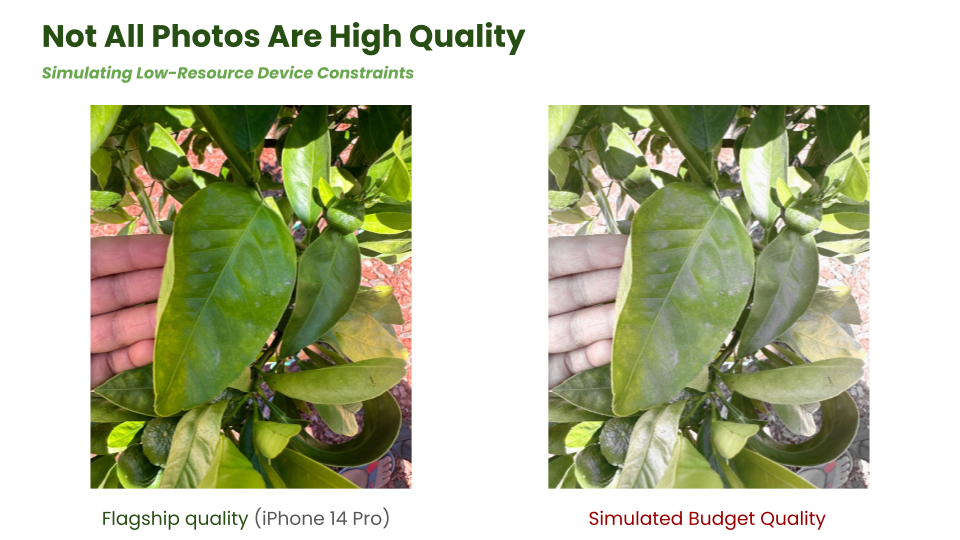
A major 2021 study published in Remote Sensing tested state-of-the-art CNNs on agricultural mapping. They found that when image resolution drops or quality changes between what the model was trained on vs. what it sees in the field, the Average Precision dropped by over 20% [1].

In his 2018 study, K.P. Ferentinos found that partial shading, human elements, and spatial displacement increased localized image misclassification to 8.33% for specific field classes, demonstrating how standard random splits struggle when a dataset is weighted toward laboratory conditions (62.7%) over real-world field data (37.3%) [2].

A 2022 study found that various state-of-the-art computer vision architectures struggle with representative datasets collected in the field, with a worst case accuracy drop from 92.67% to 54.41% as the models mistakenly overfit to background environments instead of plant lesions [3].
The Challenges of HLB Detection for Smallholders
Huanglongbing (HLB) is a harmful disease that resulted in a 95% reduction in citrus export in Florida from 2004 to 2026 [4].
Expensive costs
Commercial growers must pay $100 to $118 per sample for CDFA laboratory testing to confirm HLB presence [5].
High Labor
Manually collecting samples across thousands of trees, shipping costs, and days spent waiting for results can be frustrating.
Long Asymptomatic Period
HLB has a notoriously long asymptomatic period lasting from 2-5 years [6] in which the tree is infected and spreading the disease via insect vectors.
Other Apps Are Environment-Sensitive
Apps like Plantix achieve high accuracy in self-assessment (90%), but demonstrate hindered field performance that depends on ambient light, image sharpness, and symptom positioning [7].
Hardware & Device Limitations
Many smallholder farmers use low-cost or older smartphones. Low camera sensor quality, poor auto-exposure loops, and heavy digital noise (graininess) drastically reduce the reliability of standard computer vision models.
Possible User Capture Inconsistency
Without real-time image validation, field workers frequently upload blurry, poorly framed, or heavily clipped images. This results in high rates of false negatives during what could be a critical asymptomatic window.
Why CitraScan?
CitraScan aims to bring accessible citrus health screening to communities that may not have easy access to specialized diagnostic resources. The project focuses on building AI tools that are tested and improved by real-world growers and agricultural experts.
Scan Leaf
- Prediction based on the model’s confidence scores across three visual categories: Healthy, HLB-associated symptoms, and Nutrient Deficiency-like symptoms
- Confidence score that includes object confidence and visual disease-pattern confidence
- Reliability score to estimate sample representativeness relative to the training dataset

References
- [1] Hu, C.; Sapkota, B.B.; Thomasson, J.A.; Bagavathiannan, M.V. Influence of Image Quality and Light Consistency on the Performance of Convolutional Neural Networks for Weed Mapping. Remote Sens. 2021, 13, 2140. https://doi.org/10.3390/rs13112140
- [2] Ferentinos, Konstantinos. (2018). Deep learning models for plant disease detection and diagnosis. Computers and Electronics in Agriculture. 145. 311-318. 10.1016/j.compag.2018.01.009.
- [3] Fenu, G.; Malloci, F.M. Evaluating Impacts between Laboratory and Field-Collected Datasets for Plant Disease Classification. Agronomy 2022, 12, 2359. https://doi.org/10.3390/agronomy12102359
- [4] “Citrus Industry Crisis: Florida’s dominance devastated by disease,” Mynews13.com, 2026. https://mynews13.com/fl/orlando/news/2026/06/18/citrus-industry-crisis–florida-s-dominance-in-orange-juice-production-devastated-by-citrus-greening-disease-
- [5] K. Ross, CALIFORNIA DEPARTMENT OF FOOD & AGRICULTURE, and K. Okasaki, “CITRUS PEST & DISEASE PREVENTION DIVISION,” Sep. 2025. [Online]. Available: https://www.cdfa.ca.gov/citrus/docs/citrus_letter_2025.pdf
- [6] “Save Your Community’s Citrus Asian Citrus Psyllid & Huanglongbing.” Accessed: Jun. 30, 2026. [Online]. Available: https://awm.oc.gov/sites/ocpwocerac/files/import/data/files/64077.pdf
- [7] M. Kumar and L. Al, “A Functional Evaluation Of Plantix: An AI- Based Mobile Application For Crop Disease Management,” IJCRT, vol. 13, no. 12, p. 145, 2025, Accessed: Jun. 30, 2026. [Online]. Available: https://www.ijcrt.org/papers/IJCRTBJ02023.pdf
What Our Community Says
Growers, homeowners, and testers are helping improve CitraScan by sharing their experiences with the prototype in real-world conditions.